Respack: Biopolymers spark fierce debate over packaging’s future
What began as a technical discussion on compostable materials, recycling ecosystems and packaging innovation quickly turned into one of the most animated debates of the conference, as proponents of conventional plastics challenged the case for biopolymers and questioned whether the industry needs another material stream at all
03 Jun 2026 | 78 Views | By Sai Deepthi
The session on Biopolymer – An Alternative Material in Packaging was expected to explore opportunities and challenges surrounding compostable materials. Instead, it evolved into a sharp exchange between biopolymer advocates and supporters of conventional plastics, exposing the deep divisions that continue to shape the packaging industry's sustainability debate.
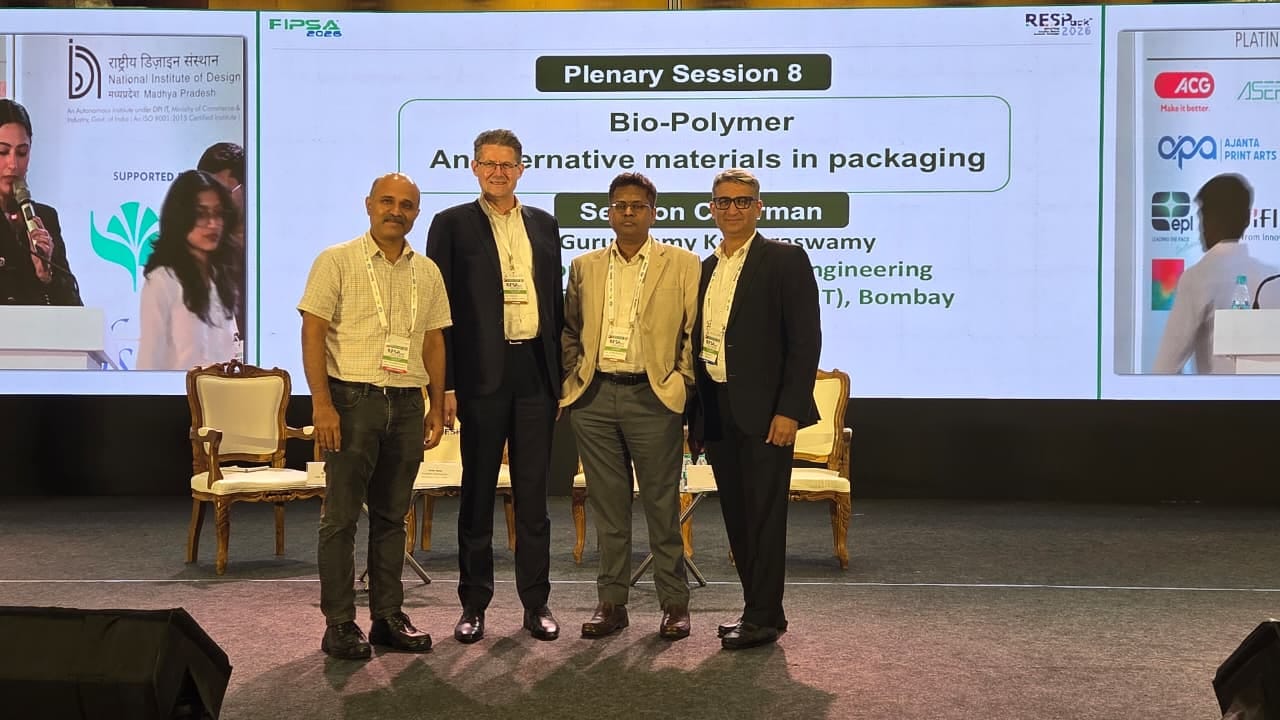
Moderated by Dr Guruswamy Kumaraswamy, the panel featured Stefan Barot, president of Balrampur Chini Mills (BCML); Dr Sunder Balakrishnan of NaturTec India; and Dr Sachin Jain of Skyi Biopolymers. The discussion began with a familiar question: can biopolymers become a meaningful part of India's responsible packaging future without disrupting existing recycling systems?
Setting the context, Kumaraswamy acknowledged concerns raised earlier in the conference regarding contamination of recycling streams by bioplastics. At the same time, he argued that packaging sustainability is too complex for a single solution. "You need multiple solutions," he said, referring to both conventional plastic recycling and compostable alternatives.
Barot, whose company is building what he described as an 80,000-tonne sugar-to-PLA plant in Uttar Pradesh, dismissed contamination concerns as a challenge that the industry must solve rather than use as a reason to reject biopolymers. "The question of cross-contamination is something we need to solve, but I don't see why that should be the problem," he said. "In the future, we need to ask ourselves, what does the carbon come from and where does it go?"
Balakrishnan took a more nuanced view, arguing that waste management requires coexistence rather than competition between technologies. "When you look at waste, it's a very complex problem and there's no silver bullet," he said. He argued that recycling works well where materials can be efficiently collected and retain commercial value. Compostable plastics, however, have a role in applications contaminated with food waste, where conventional recycling becomes difficult. "When you have a conventional plastic and you are connecting it with food waste, you are neither making the plastic recyclable nor are you treating it as an organic waste," he said. "Here is where compostable plastics add a lot of value."
Jain echoed the view that success depends less on material science and more on systems. "No stream of any material recycling can be effective unless and until there is an ecosystem," he said. "The systems are no different. It's just how you implement the ecosystem."
The discussion then shifted from end-of-life management to market adoption. With BCML investing in large-scale PLA production, Kumaraswamy asked where the biggest opportunities would emerge. Barot pointed directly to single-use plastics and future carbon-neutrality commitments. "A lot of brand owners are starting to realise that this is the future," he said. "How are we going to be carbon neutral in 2070 if not to recycle fossil-based materials?" He also suggested that younger consumers are increasingly willing to pay a premium for environmentally preferable packaging."There are young people out there who are willing to pay for this if we get a clear signal," he said.
One of the most striking moments of the session came when Balakrishnan challenged the industry's discomfort with the word "plastic" itself. "Bio-polymers are also thermoplastic," he said. "Unfortunately, it is a plastic or fortunately it is a plastic, however you want to look at it. I think we need to get away from being shy to say the word plastic." He argued that bioplastics are often unfairly compared with highly optimised conventional plastics that have benefited from decades of development. "We have to be patient with the material," he said. "Let's not throw it out before the material is out there."
According to Balakrishnan, significant work remains in barrier properties, processability and product performance. The challenge, he noted, is improving functionality without compromising compostability. "If you make it too strong, you will lose the compostability," he said. The conversation remained largely constructive until the audience Q&A session, where the debate became noticeably sharper. An audience member questioned whether industrially compostable materials truly solve India's waste-management challenges, pointing out that composting infrastructure remains limited. The challenge drew an animated response from Barot. "I always hear a hundred reasons why something is not working, and never the question of how we can make it work," he said.
The exchange intensified when Dr Vijay Habbu questioned the core premise behind compostable materials. "If a certain material has to go to landfill or compost, it has to be collected," Habbu said. "If there is collectability that is given to PLA or any other material, why can't the same collectability work for PET?" Habbu also challenged claims around environmental benefits, noting that both composting and landfill degradation can generate greenhouse gases. The discussion then shifted from packaging infrastructure to the broader philosophy of material choice.
Barot responded by defending the carbon credentials of biobased materials. "If you have a biobased carbon then you release it back into the environment as CO₂, we have no pollution," he argued. "Sugarcane already absorbed the CO₂ from the air to generate sugar." The debate became increasingly animated as questions around recycling, contamination and circularity were raised. At one point, Barot challenged assumptions around recycled PET, while Habbu countered that no recycling system is perfect and every material comes with trade-offs.
Barot also challenged the assumption that collection infrastructure automatically favours conventional plastics. He argued that both PLA and PET require effective collection systems, but the more important question is which material can be integrated most effectively into a circular economy. While acknowledging that collection remains essential regardless of material choice, he expressed concerns around the limitations of recycled PET in certain food-contact applications and questioned whether recycling alone can address all challenges associated with packaging waste. In his view, compostable materials should be seen as an additional pathway rather than a replacement for existing waste-management systems.
Balakrishnan argued that the industry's focus on end-of-life management often overlooks an equally important question: where the carbon used to make packaging originates. He said discussions around biopolymers tend to concentrate on compostability and waste management, while paying less attention to the potential value of building a materials economy based on renewable feedstocks rather than fossil-derived raw materials. According to him, the debate should not be limited to disposal routes but should also consider whether packaging materials can help reduce dependence on petrochemical resources.
He also cautioned against treating compostability as a universal requirement for every biopolymer application. He said material selection should be driven by end use rather than ideology. Using the example of a PLA-based mobile phone case, he argued that a durable product designed for long-term use does not necessarily need to be compostable. In such cases, recyclability, may be the more appropriate route. The key, he said, is identifying the best fit between material properties, infrastructure and application requirements rather than applying a single solution across all categories.
As the session drew to a close, there was no consensus on whether biopolymers represent the future of packaging or merely one of several parallel pathways. What became clear, however, was that the industry's conversation has moved beyond simple questions of recyclability.
The debate is increasingly centred on carbon sources, infrastructure readiness, economics, consumer behaviour and application-specific performance. If the intensity of the discussion was any indication, biopolymers remain one of the packaging industry's most contested subjects and one that is unlikely to be settled anytime soon.