The packaging paradox: Life is not easy for the delivery rider
As India’s gig economy accelerates, the push for hyper-efficient packaging and rapid deliveries is exposing a human cost—where algorithms optimise boxes and routes, but delivery riders shoulder the risk, exhaustion, and economic uncertainty.
24 Feb 2026 | 1240 Views | By Prabhat Prakash
Four months after he had moved from Jaunpur to Mumbai, Aftab, a delivery partner for Zomato, had an accident. The incident highlighted not the tale of a budding career in the burgeoning gig economy but a precise mathematical problem, the kind only a hyper-efficient corporate algorithm could devise. When Aftab had his accident, the critical failure point in the vast, multi-billion-dollar system was not the physical injury to a human being—a torn ligament, a cracked helmet—but the single, unfulfilled delivery order.
Rizwan, Aftab’s older brother, shared the chilling detail: while Aftab was paying out-of-pocket for a hospital visit that would cost him several days’ wages, the Zomato helpline, rather than offering assistance, was enquiring about the status of the parcel. The gleaming surface of urban consumption, it turns out, is built upon a substratum of human endurance. In the digital logistics casino of 2026, the question is not whether the system is fair, but how much the real Atlas on the scooter must carry before the math finally breaks.
This is where the packaging paradox comes into play. When we spoke to a senior packaging scientist at one of the e-commerce companies at the ElitePlus conference, he said, "This is the contradiction where the engineering triumph of efficient, waste-reducing packaging for the brand creates a physical challenge and increased risk for the delivery rider."
Flipkart's machine learning (ML) models, which determine 40 different, perfectly-fitting box sizes to reduce waste and optimise space (known as 'cube utilisation'), contribute to this paradox by making the packages physically heavy and tightly packed. While this is a win for the brand, for the rider, lugging these heavy, tightly packed bags increases the risk of a spill or a declined order. A single cancellation due to a packaging mishap can lead to a total loss of earnings for the rider's day.
According to the NITI Aayog report India’s Booming Gig and Platform Economy, the sector is projected to reach 2.35-crore workers by 2029-30, making 2026 a pivotal turning point for labour reforms. Industry experts estimate that 20-lakh additional gig workers will be needed this year alone to meet the demands of a burgeoning middle class. During the 2025 festive season, gig and temporary jobs rose by 25% compared to 2024, reflecting the massive scale of this permanently temporary workforce.
A logistics casino
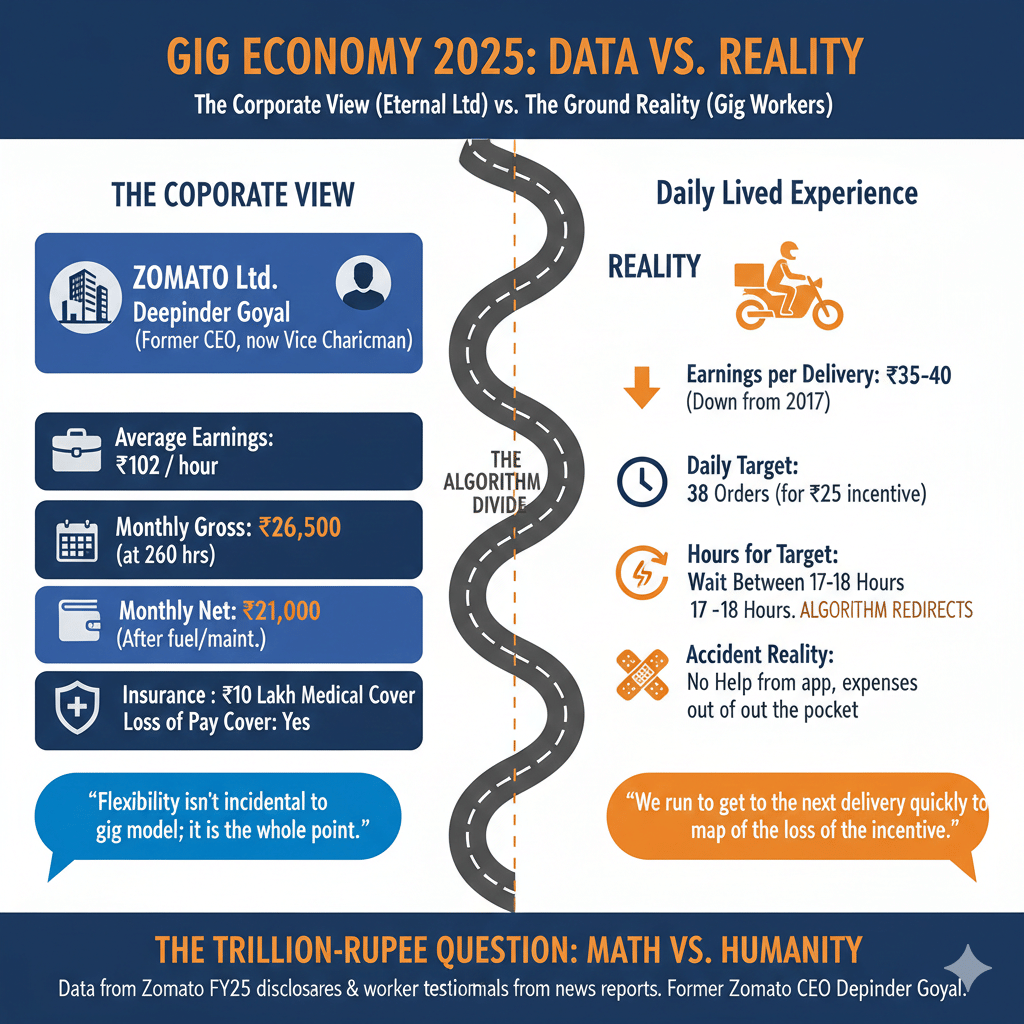
For the consumer, the app is a miracle of efficiency. For the rider, it is Hobson’s choice: take the gig or take nothing. Deepinder Goyal, former CEO of Zomato, defends the model as India’s largest organised job creation engine. In a viral New Year's Day post on X, Goyal shared that Zomato and Blinkit delivered over 75-lakh orders to 63-lakh customers on New Year's Eve, an all-time high, unaffected by strike calls. "If a system were fundamentally unfair," Goyal argued, "it would not consistently attract and retain so many people who choose to work within it."
However, on the scorching asphalt, we can hear a different story. Shaik Salauddin, founder president of the Telangana Gig and Platform Workers' Union (TGPWU), counters that the pressure of hyper-fast delivery is a source of "mental and physical stress." He claims that despite Goyal's narrative of record orders, peaceful strikes resulted in delays for 60% of orders in several pockets. "This was just a teaser," Salauddin warned, "more is yet to come."
The evolution of the delivery box is often seen as a triumph of engineering. Sri Krishnan J of Flipkart, speaking at the Pack. Nxt 2025 summit, touched upon cube utilisation. He explained that Flipkart uses machine learning (ML) models to determine 40 different box sizes to ensure that every SKU fits perfectly, reducing waste and optimising space.
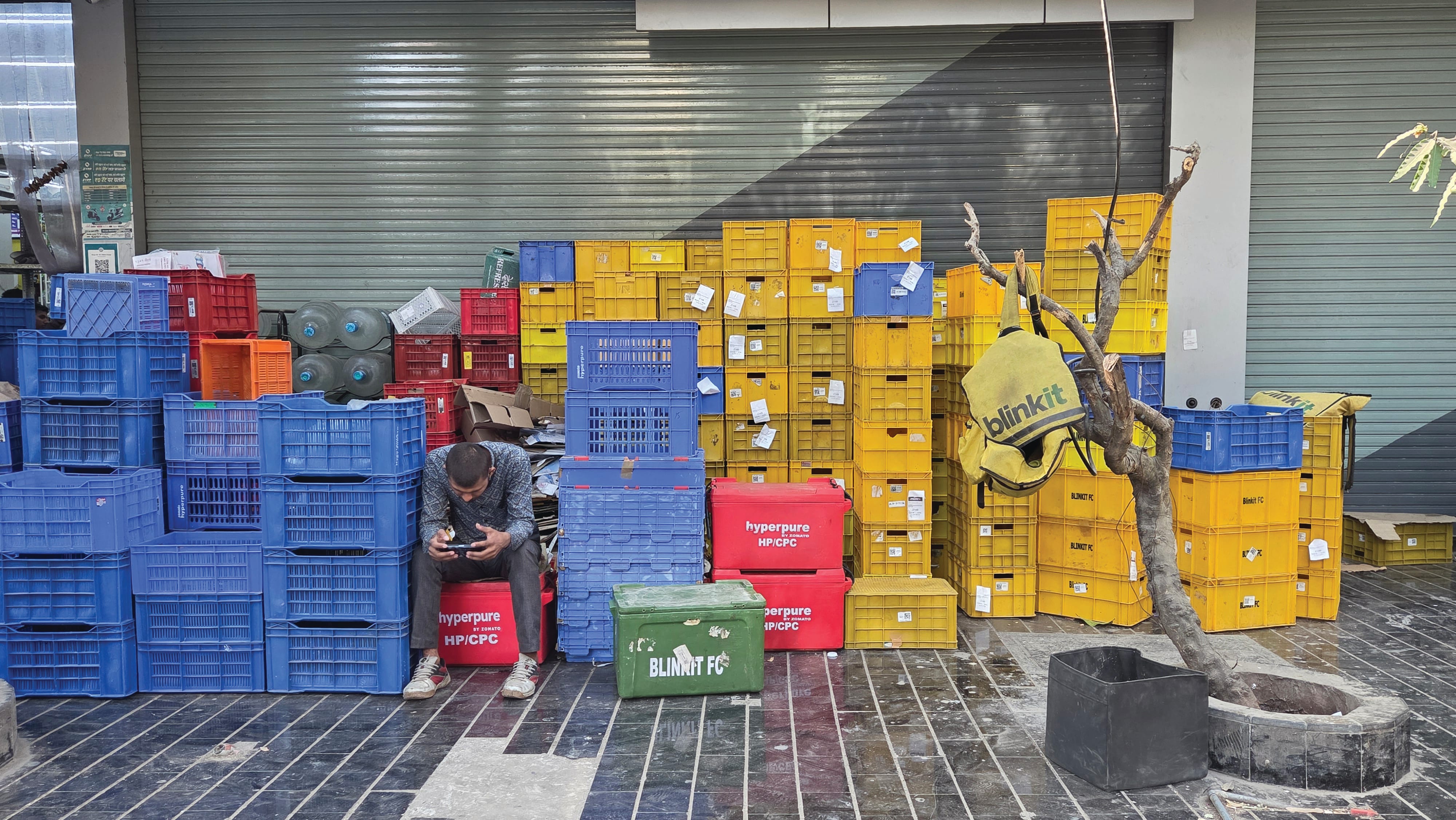
While workers struggle, India's appetite remains insatiable
Stories of survival
The human cost is etched into the daily routines of those on the road. Praveen (32), a local rider from Maharashtra, notes that while packaging has improved with tamper-proof seals, the pressure of traffic remains a constant threat. "We are protesting for our insurance and other incentives," he says.
"We don't just run for the time; we run to get to the next delivery quickly for the incentive." For veterans like Sachin (48), who has been with Swiggy since 2017, the gig is a story of diminishing returns. He describes a reduction in earnings: "Earlier, we used to get INR 35-40 per delivery. Now, we get INR 25. Due to the increasing price of petrol, our income has decreased."
Suresh Kumar Savita (53) highlights the exhaustion caused by the incentive system. "To complete 38 orders, you have to work 17-18 hours. They set targets but don't give enough orders as they outsource to third-party apps like Shadowfax and Rapido," he says. Savita claims he often waits hours between orders, losing his daily incentive because the algorithm redirects work away from him. For the younger generation, like Abhishek Pande (18), who works for Magicpin, the gig is merely a waiting room. "I want to become a YouTuber," he says. "The day one of my videos goes viral, I will leave it."
Strategic analyst Prem Soni views this as the permanent end-state of India's economy. "Gig work is the most honest labour market India has ever created," Soni posted on X. "When delivery partners protest, they are not rebelling against injustice. They are rebelling against math. And math doesn’t negotiate." But math has a human breaking point.
Rizwan (40), who also moved from Jaunpur to Mumbai with his brother Aftab four months ago, found that city expenses left him with nothing. He talked about his brother Aftab’s accident. "When the accident happened, the Zomato helpline was contacted, but no assistance was provided," Rizwan shared. "The customer service kept enquiring when the order would be delivered." Aftab had to pay out-of-pocket for medical expenses, leading to a loss of pay for several days before returning to the grind.
A 90-day barrier
The government’s Code on Social Security (2020) and the registration of 5.12-lakh platform workers on the eShram portal are massive steps forward. MP Raghav Chadha hailed the draft rules as a "landmark first step toward recognition and dignity." The rules mandate that aggregators contribute 1-2% of annual turnover to a Social Security Fund. However, a new barrier appeared in 2026. The Social Security Code (Central) Rules, 2025, proposed a 90-day annual work threshold for workers to access benefits. For those juggling multiple apps, the threshold is 120 days. While the rules allow for cumulative counting, union leaders argue that this still excludes many migrant workers who only stay in cities for peak seasons.
A feast for the future?
While workers struggle, India’s appetite remains insatiable. Swiggy’s How India Swiggy’d 2025 report paints a vibrant picture of a nation that ordered 93-million biryanis and 11-million idlis for breakfast. Individual stories stand out, like Mohammad Razique from Bengaluru, who delivered a staggering 11,718 orders in a single year, or Poongodi from Chennai, who led female partners with 8,169 deliveries.
In 2025, our collective relationship with food shifted from a simple means of sustenance to a vibrant expression of culture. But the most significant shift of 2026 has been the indus try's quiet retreat from the hyper-speed model. The controversial 10-minute delivery promise has been removed, a concession to the mounting pressure from safety advocates and the workers themselves, who had reached a breaking point.
Demanding dignity
The industry's quiet, necessary retreat from the controversial 10-minute delivery promise marks the end of an era of artificial, unsustainable urgency. The physical act of riding is now perhaps a bit slower, yet the "logistics casino" remains. In the world built by Zomato, Swiggy, and Blinkit, the core principle remains the same: the system runs on the backs of individuals like Sachin, Suresh, and Aftab.
In Ayn Rand’s world of fiction, the entrepreneur is the Atlas who carries the world: In the new Indian economy, the real Atlas is a 26-year-old on a scooter. As the gig workforce surges towards 2.35-crore, the algorithm no longer demands a fixed 10 minutes, but it still demands the rider’s day and night, leaving the central moral work not to the company's valuation, but to the methodical, agonising laying out of time, distance, and money. The ultimate challenge is not just to regulate the hours, but to ensure the dignity of the deliverer remains a constant, non-negotiable variable, along with the packaging. All eyes in 2026 are on what's next.