TAF Connect 2026 opens with a sharp warning on counterfeits, and a stronger call for traceability
At TAF Connect 2026, the opening session set the tone for the day: counterfeiting is no longer just a brand protection issue. It is a consumer safety issue, a supply-chain issue, and increasingly, a packaging issue
18 Mar 2026 | 1682 Views | By Sai Deepthi
The event began with registration and networking over tea and coffee, followed by the ceremonial lamp lighting led by the guest of honour and members of the ASPA governing body. Ankit Gupta, president, Authentication Solution Providers’ Association (ASPA), framed the day around a simple but powerful provocation: what would the market look like if counterfeit products did not exist? Gupta said the objective of bringing the industry together at TAF Connect 2026 was clear: to ensure that consumers receive authentic products, and to encourage more brands to publicly acknowledge and collectively address the scale of the counterfeiting challenge.
He noted that while counterfeiting affects multiple sectors, many companies still remain reluctant to speak openly about it. Platforms such as TAF Connect, he said, help create the kind of industry-wide dialogue needed to move the issue from isolated concern to coordinated action.
In his welcome address, Gupta also used the occasion to reflect on the growth of ASPA itself. Founded in 1998 as a unified voice for the authentication and brand protection industry, the association today has more than 80 members and is expanding its international footprint, including the launch of its Middle East chapter last year.
He emphasised that the fight against counterfeiting cannot be left to regulators or enforcement agencies alone. It requires active participation from brands, solution providers, converters, packaging specialists and consumers.
Gupta cited awareness initiatives by companies such as Mankind Pharma as examples of how industry can engage more directly with consumers, particularly in high-risk sectors such as pharmaceuticals. In these programmes, consumers are educated on how to spot fake medicines, including basic but telling signs such as spelling or grammatical errors on packaging.
That point resonated strongly in a room filled with stakeholders from packaging, printing, labelling, security solutions and brand protection.
Report launch gives the discussion hard numbers
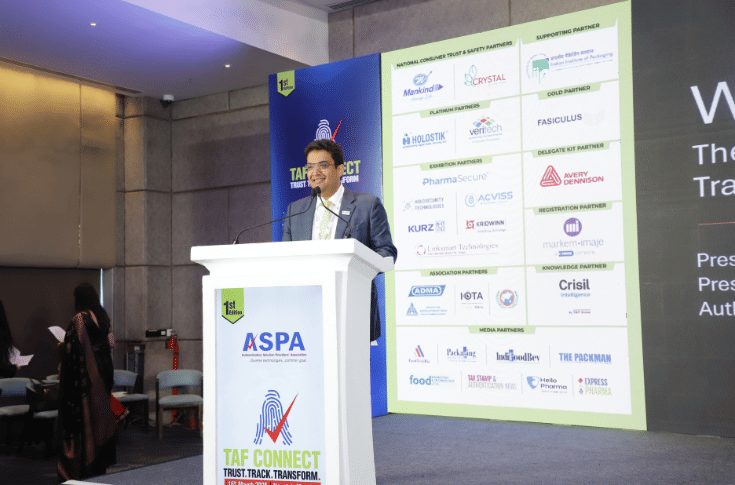
The inaugural session also saw the launch of the ASPA-CRISIL State of Counterfeiting Report 2025, presented by Anjali Nathwani, director, CRISIL Consulting. The report gave the day’s discussion a hard statistical foundation. Based on 1,639 respondents, it found that 89% of consumers have encountered counterfeit products, while 35% admitted to purchasing one in the past year. Counterfeit purchases, according to the study, have risen 1.8 times in the last 12 months, with online aggregators accounting for 50% of reported sources.
The findings also revealed a troubling gap in consumer awareness. One in four respondents (25%) said they were unaware they had purchased a counterfeit product, while 7% said they had no alternative option. Once a counterfeit was identified, 50% said they would complain, 32% said they would discard the product, and only 10% said they would continue using it.
Sector-wise, the report found the highest prevalence of counterfeit exposure in apparel (34%), followed by consumer durables (31%), pharmaceuticals (28%), and FMCG (25%).
For the packaging community, the report’s implications were immediate and practical. The data reinforced the need for stronger authentication, labelling integrity, packaging design safeguards, and traceability systems across both physical and digital retail channels.
Rajesh Kumar Mishra links counterfeiting to safety, exports and enforcement
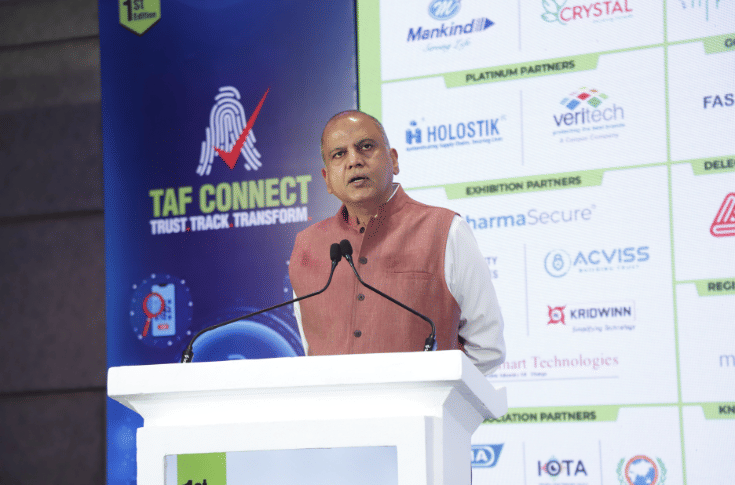
In one of the strongest addresses of the session, Rajesh Kumar Mishra, director, Indian Institute of Packaging (IIP), and additional DGFT, Mumbai, positioned counterfeiting as an issue that goes well beyond economic loss.
He told delegates that counterfeit goods have a direct and dangerous impact on both human and animal health, especially in sectors such as pharmaceuticals, where fake medicines can be life-threatening. His intervention was particularly relevant for a packaging-focused audience because it underscored how authenticity is tied not just to compliance, but to public safety.
Mishra said any consumer who pays for a product is entitled to receive a genuine one. While the government can create the policy framework, he added, awareness and vigilance must also come from society. Consumers who encounter suspicious or “first copy” products should report them to the appropriate authorities.
He also linked the issue to India’s export ambitions. Referring to global opportunities in regulated sectors such as pharmaceuticals, Mishra pointed out that markets such as the UK import over USD 100 billion worth of medicines. With the right quality systems, technology and packaging-backed trust mechanisms, Indian manufacturers are well positioned to serve such markets.
That remark connected neatly with the broader theme of the event: in export-led industries, authentication is not just about preventing loss, it is about enabling market access.
Another key takeaway from Mishra’s address was the effect of counterfeit goods on industrial planning and supply-chain credibility. Drawing on his experience with enforcement systems, he noted that counterfeit and smuggled products often move through the market in plain sight. When consumers and channel partners normalise “first copy” or “second copy” products, it weakens trust in legitimate supply chains and erodes the value of compliance.
For packaging professionals, this observation lands close to home. If a pack, label or code can be copied easily, the integrity of the brand promise collapses. The inaugural session therefore did more than diagnose the problem. It reframed the role of packaging, printing and authentication technologies as strategic tools in restoring trust.