


BCML PLA Bioplastics plant to be operational by October 2026
Balrampur Chini Mills' PLA biopolymer plant is in the news. Sai Deepthi interviews Stefan Barot and the tech team to explore how sugarcane is being reimagined from crop to eco-material
23 Dec 2025 | By Sai Deepthi P

Vision and investments
Sai Deepthi (SD): What inspired BCML (Balrampur Chini Mills) to make its largest-ever investment of INR 2,850-crore in the polylactic acid (PLA) biopolymer project?
Stefan Barot (SB): The idea came to me when I saw a bottle online that claimed to be made from sugarcane. It was fascinating to see how something so intrinsic to India’s agricultural identity could be harnessed to create eco-friendly alternatives to single-use plastics. That moment inspired us to explore how BCML could leverage its integrated agrisupply chain and industrial capabilities to produce biopolymers like polylactic acid (PLA), thereby driving environmental and economic impact.
The INR 2,850-crore investment in PLA bioplastics project reflects our commitment to sustainable innovation and long-term value creation. The vision was to reimagine sugarcane as a renewable feedstock for advanced, low-carbon materials that can meaningfully contribute to India’s circular economy and global sustainability goals. The PLA plant will be ready by October 2026.
SD: Can you elaborate on the key incentives or commitments provided under the MoU with the UP government, and how this partnership supports the Kumbhi project?
SB: Uttar Pradesh’s Bioplastics Policy, the first of its kind in India, has also played a catalytic role in encouraging such investments. It has provided a strong policy framework and confidence for industries like ours to innovate, diversify, and invest in sustainable manufacturing at a commercial scale. The MoU signed with the Government of Uttar Pradesh provides a strong framework of support and incentives that are critical to the success of our biopolymer project in Kumbhi, Lakhimpur Kheri. It also facilitates the plant’s operation on 100% renewable energy, reducing the carbon footprint of the production process.
SD: How does your collaboration with Konkan Speciality Polyproducts (Konspec) strengthen BCML’s capabilities in speciality polymers and compliance with EPR or sustainability regulations?
SB: The partnership between BCML and Konkan Speciality Polyproducts (Konspec) brings together complementary strengths in feedstock innovation and polymer engineering to accelerate India’s transition toward sustainable materials. With over three decades of experience, Konspec adds deep R&D and application development capability, enabling us to extend beyond basegrade PLA into tailored compounds suited for diverse uses, from flexible packaging and moulded articles to industrial components.
This integration strengthens BCML’s portfolio while supporting faster commercialisation and product differentiation.
BCML will initially focus on eight BioYug grades
Sustainable operations
SD: How does co-locating the PLA plant with your sugar mill create operational synergies in terms of feedstock, utilities, and waste management?
SB: The integrated set-up enables a continuous and efficient flow of feedstock, sugarcane and its derivatives, from the mill directly to the PLA facility, reducing logistics requirements, improving reliability, and minimising handling losses. The proximity allows the use of specific sugar quality resulting in the lowest overall operational costs from sugar cane to PLA. The shared infrastructure for power, steam, and water further enhances efficiency. Our renewable cogeneration systems, powered by bagasse will supply clean energy to the PLA plant, resulting in lower operating costs and carbon footprint.
In addition, the co-location facilitates a circular approach to waste and by-product management, where process residues from one operation can be effectively utilised in another.
SD: Are existing cogeneration or ethanol plants being modified to supply renewable energy to the PLA process?
SB: The location of the BCML ethanol plants at the PLA plant are different. The synergy will be in the people where experience from the fermentation can be transferred allowing for a faster start of the R&D activities in the Lactic Acid fermentation.
SD: The plant is designed to operate on 100% renewable energy. What mix of renewable sources will be used, and how will you ensure round-the-clock reliability?
SB: At the start most of the renewable energy will be from the bagasse like in the sugar and ethanol plant and only a small fraction will be from other biomass-waste. However, bagasse is a valuable resource, and the share of biomass-waste is targeted to increase to a substantial fraction in the next few years. With additional capacity this will eventually rise to over 50% of the total energy mix.
SD: Will the sugarcane used for PLA be Bonsucro-certified, and how do such certifications contribute to supply chain traceability and biodiversity protection?
SB: BCML helps its suppliers, the farmers to certify their production as Bonsucro. This has already been achieved and completed for some farmers in the region and BCML is in the process to intensify this, in collaboration with all of its farmers. We are also interested and actively support traceability of the PLA for the total value chain. Such an IT supported system will allow brand owners and eventually customers to track and trace biobased and compostable materials throughout the value chain.
SD: Bioyug PLA emits 68% less greenhouse gas than conventional plastics. What are the main contributors to this?
SB: Unlike petrochemical plastics, which rely on crude oil or natural gas, PLA is produced from plant-derived sugars, in our case, from sugarcane, where the carbon absorbed during cultivation offsets a substantial portion of emissions generated during processing. Additionally, the PLA production process typically operates at lower temperatures and uses cleaner energy sources, further reducing its carbon footprint. At our integrated Kumbhi facility, this advantage is amplified through the use of renewable power and steam generated from bagasse, a byproduct of sugar milling.
Finally, end-of-life considerations also contribute: PLA’s potential for compostability or recycling prevents long-term carbon accumulation compared to conventional plastics. Together, these factors make PLA a much more climate-responsible alternative within the polymer value chain.
Process innovation
SD: What were the major scale-up challenges for achieving 80,000-tonnes-per-year capacity, and how were they resolved?
SB: The Kumbhi facility, currently under construction, will be India’s first industrial-scale, fully integrated PLA biopolymer plant, producing PLA directly from sugarcane. The main challenge is in the speed to build a green-field plant in 30 months. Other already established companies build the same capacity in 48 months. Such a short time-line is only possible with a dedicated and experienced team with a relentless focus. The other main achievement is the cost of INR 2,850-crores which is approximately 50% lower than other current plants. This requires a relentless focus on the required functionality at the lowest CapEx and OpEx. Here some main optimisations were achieved, reducing OpEx with limited additional CapEx.
SD: Can you discuss the technologies, catalysts, or partners used in the lactide synthesis and polymerisation steps, and why these were chosen over alternatives?
SB: We value our technology partners, which were revealed in our first announcement in February 2024. The partner for Lactic Acid is Alpine from Austria and Sulzer from Switzerland for Lactide and PLA. Sulzer was chosen for their technical expertise and technology which is used by the existing global PLA producers. Alpine was chosen because of their experience in fermentation and the compatibility of their process with Sulzer. All processes are under non-disclosure agreement (NDA) with the technology providers and further details cannot be revealed, however they follow the processes described in literature.
SD: How is consistent product quality ensured at industrial scale, and what in-line testing protocols are followed?
SB: This is a fully continuous process with centralised operational control and over 10,000 analogue and digital measuring points. Samples will be taken along the production at strategic points. The analytical results of these samples combined with the statistical analysis of the measuring points will enable a production at constant quality. The final PLA will be tested according to the established international test protocols. Very little commercial offerings for in-line testing of key parameters tailored for the process globally exists. BCML is working on a limited number of key-in-line measurements. An example here is the colour of the lactic acid. A dedicated R&D team will work in a technical set-up and with the customer to ensure BCML understands the requirements of the PLA for each application and each customer.
About Bioyug PLA
SD: What are the key specifications and performance characteristics of Bioyug PLA?
SB: Balrampur Bioyug’s PLA is derived entirely from sugarcane, and is certified industrially compostable, positioning it as a sustainable alternative to conventional plastics. Compared to traditional plastics like PET and PP, which rely on fossil fuels, PLA combines high-performance characteristics with environmental responsibility.
SD: How many PLA grades will you commercialise and are there co-polymers under development?
SB: The BCML PLA plant will easily and quickly change melting point, speed of crystallisation and melt-flow index. BCML will initially focus on eight Bioyug grades covering 90% of the PLA required to cover the common applications. The plant will be flexible to allow a production of more customer focused grades for specific applications if the demand exists. We will not enter the production of compounds and blends as this will directly compete with its customer base. If production of co-polymers is meaningful, it will be decided once the current production is operational.
SD: How can Bioyug PLA overcome challenges like limited heat resistance and barrier properties?
SB: Crystalline PLA withstands temperatures of over 100* C and can be used in microwaves and for hot food. A compound with a nucleating agent, can be processed on existing equipment to allow for heat resistance. For applications with high barrier property requirements, the industry now uses multilayer packaging (MLP), traditional fossil-based polymers are also not the sole solution. However there will always be trade-offs as functionality, processability and circularity need to be combined and optimised in a holistic way.
SD: Which end-use sectors will you target first, and do you already have launched customers in packaging?
SB: We are positioning our biopolymer business, branded Balrampur Bioyug, to target the packaging and food-service sectors. Balrampur Bioyug is a bio-based PLA resin derived from sugarcane, engineered to replace fossil-based plastics. BCML plans to supply this resin to small and medium enterprises (SMEs). This initiative accelerates India’s transition to compostable, sugarcane-based materials.
SD: Are there plans to expand capacity or export Bioyug PLA?
SB: As the first mover in this space, we recognise the responsibility of acclimatising the market to a new, transformative material like PLA and helping consumers, industries, and policymakers understand its potential as a sustainable alternative to conventional plastics. To expand market reach, BCML is combining technological innovation with public engagement initiatives like Bioyug on Wheels. This promotes awareness of bioplastics among consumers, manufacturers, and policy stakeholders. This outreach complements national missions such as Atmanirbhar Bharat and Viksit Bharat, aligning Bioyug’s growth with India’s sustainable development goals.
SD: How do you create awareness beyond initiatives like Bioyug on Wheels?
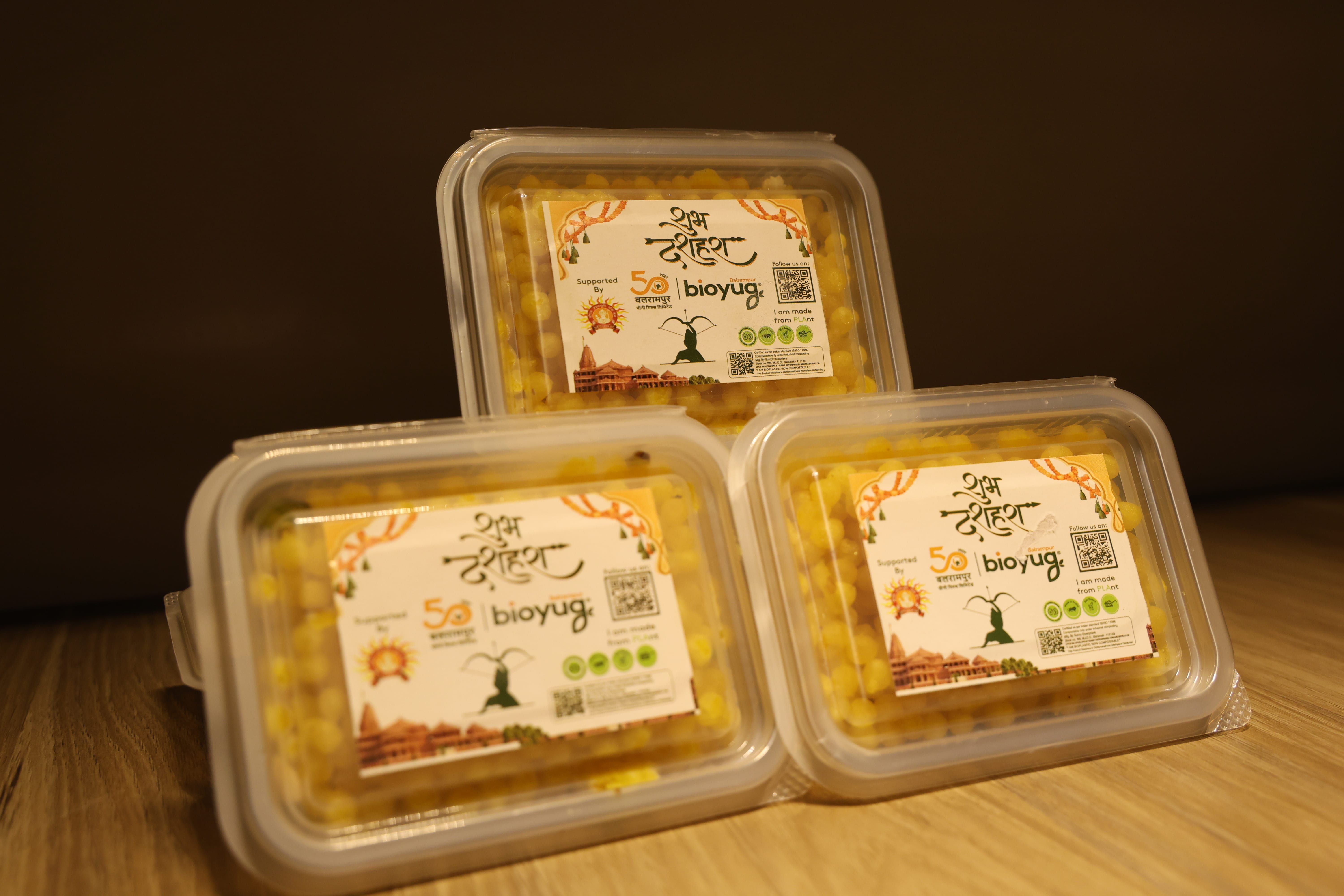
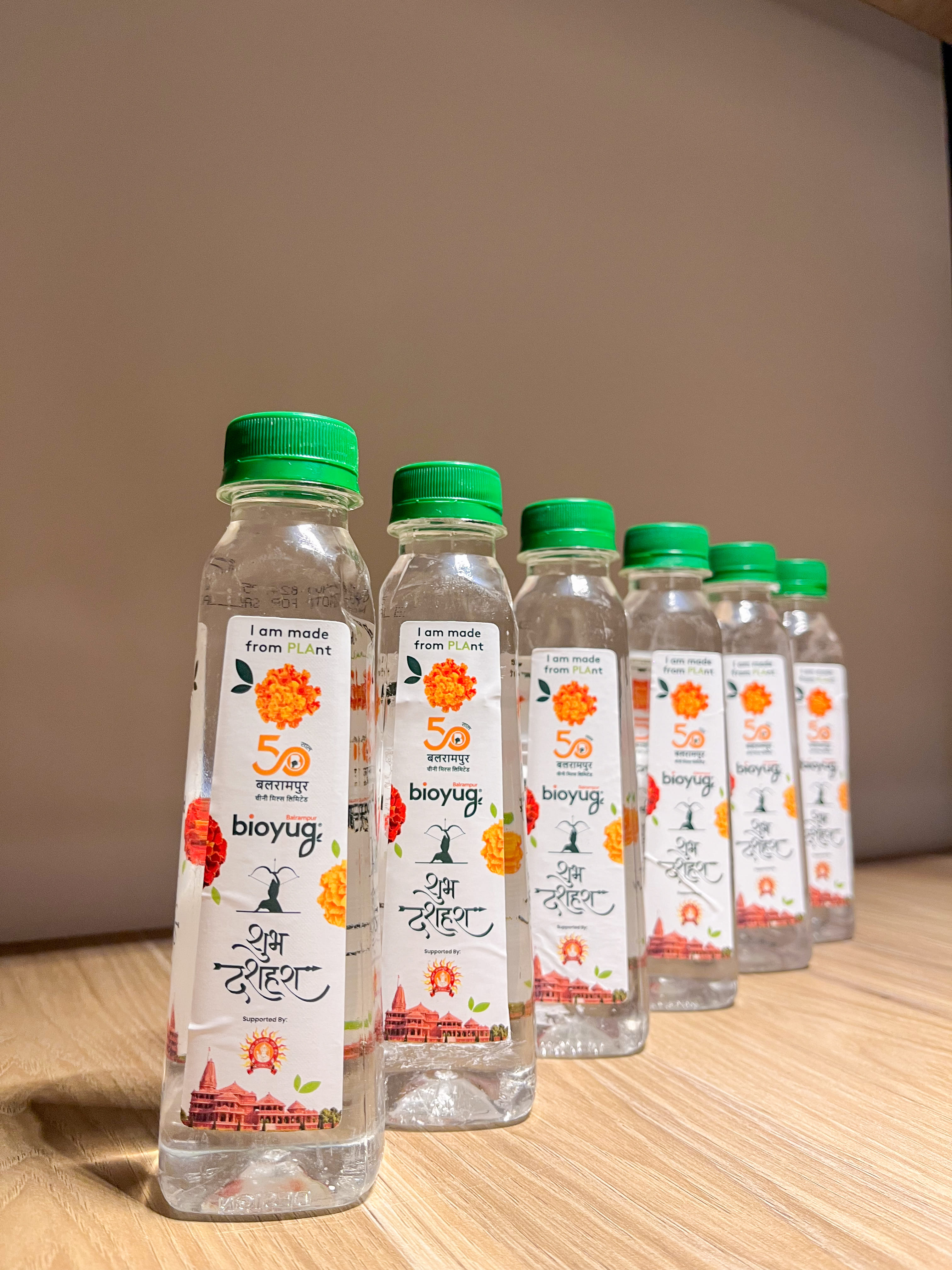
SB: Beyond Bioyug on Wheels, we are taking a culturally resonant approach to engagement. For example; our collaboration during the Dussehra festivities at the Shree Ram Mandir in Ayodhya, where eco-friendly PLA-based prasad boxes and water bottles were distributed. Looking ahead, we plan to scale up production capacity and explore export markets, leveraging India’s agricultural strengths.
