


W&H Alphaflex: Solving the flexo headache for Indian converters
During Plastindia 2026, held at Bharat Mandapam from 5 to 10 February, Windmoller & Holscher (W&H) celebrates a breakthrough year for its Alphaflex CI flexo press, with eight machines sold in India since its launch. Sales and marketing director, Anuj Sahni explains how the press is tackling the process variables that previously held the technology back
17 Feb 2026 | By Abhay Avadhani

Alphaflex achieves 500-m/min production speeds, even with complex, "high-bounce" designs
Talking about the show, Anuj Sahni, sales and marketing director, W&H says, “In the previous editions of Plastindia, we saw visitors from every industry. This year, the footfall is more focused, industry-specific plastic processors who know exactly what they are looking for.”
The most prominent “ask"”at the W&H stand is sustainability, specifically driven by the burgeoning start-up culture in India. From specialty coffee to health foods and protein powders, new brands are demanding short-run, customised, and eco-friendly packaging.
For W&H, this has translated into an unprecedented success story for their latest CI flexo press, the Alphaflex and also extrusion business.
Alphaflex Success in India
While the industry has long debated flexo vs gravure, Sahni is quick to reframe the discussion. “It’s not versus; it’s flexo ‘and’ gravure. The two technologies complement each other,” he notes. However, he acknowledges that flexo has historically been plagued by too many process variables.
“In gravure, a job often runs with ease. In flexo, you have to tweak it, but these tweaks are not so easy to achieve sometimes. Customers often have to accept lower performance than deal with the headache,” Sahni explains. This is the specific problem the Alphaflex was designed to solve.
Originally conceptualised as an entry-level machine, Alphaflex offers innovative features and imbeds a powerful and stable design making it a performance benchmark in the industry. Result – difficult jobs at high speeds without any tweaking possible.
“We have taken jobs that previously required staggering and are now printing them without it, at much higher speeds,” Sahni adds. The press now makes 500-m/min production a very achievable performance level.
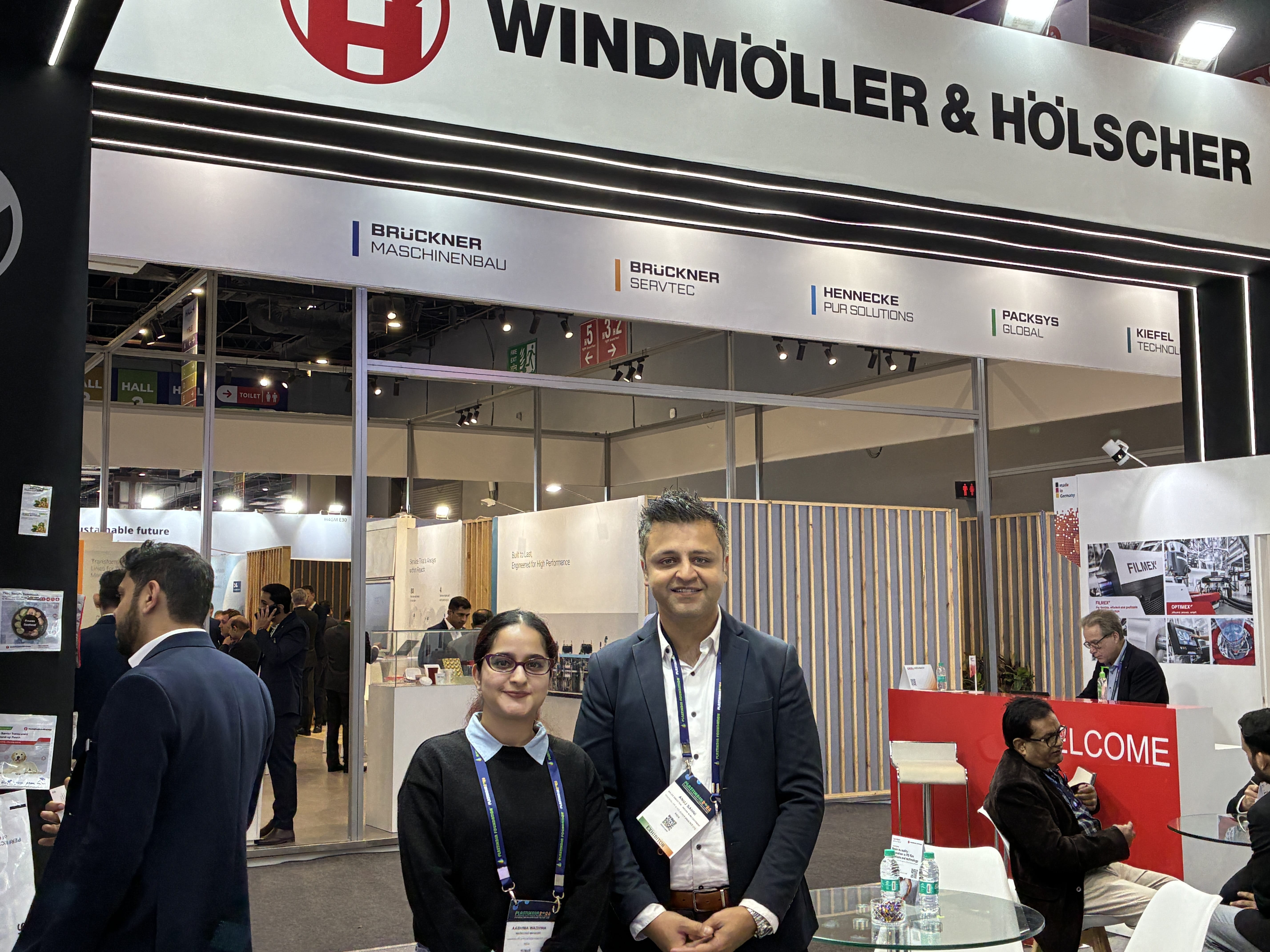
Aashima Wadhva and Anuj Sahni of W&H at Plastindia 2026
The single-material trend
The shift towards sustainability is no longer theoretical; it is visible in the commercial samples on display. Sahni points to the calculated growth of PE/PE and PP/PE laminates, with few Indian brands moving away from conventional PET/PE structures to meet recyclability mandates.
India being a PE blown market for laminates has also started to consume a good amount of CPP films and the consumption is growing. Growth of CPP is because of the CPP/BOPP single material structure which is gaining traction.
Simplifying the “rookie” experience
A major hurdle for Indian converters has been finding skilled operators who can handle complex flexo setups. Sahni notes that W&H addressed this by including the Easy Setup assistance system. This guides operators through the setup process step-by-step, ensuring that even a newcomer can achieve the same quality as an expert.
Whether it is the longest drying tunnel in its class or high-speed roto performance—where 500-m/min is now becoming the norm, the message from W&H at Plastindia 2026 was clear: The Indian market has reached a threshold where high-end technology is no longer a luxury, but a baseline requirement for any converter looking to serve the modern, conscious consumer.
On the Plastindia show floor: W&H Alphaflex highlights
Performance: Achieving 500-m/min production speeds, even with complex, "high-bounce" designs.
Sustainability: Specifically designed for mono-materials (PE/PP) and paper, with 25% lower drying energy consumption.
Automation: Features Easy Setup and intelligent register/impression setting for consistent quality across shifts.
Connectivity: Every machine includes Ruby Essentials, W&H’s IoT system for digitising the supply chain.
Specifications: Eight color decks; print widths from 820-mm to 1,270-mm; maximum repeat length of 800-mm.