


How IIP is strengthening India’s packaging capability for global markets
With new laboratories, expanded testing infrastructure and a stronger focus on education, certification and incubation, the Indian Institute of Packaging is building the systems required to help Indian packaging meet international regulatory expectations and perform reliably across global supply chains. Shekar Amberkar, deputy director and head of the International Packaging Centre at the Indian Institute of Packaging in conversation with the WhatPackaging? team
29 Dec 2025 | By Noel D'Cunha

The most fundamental shift at the Indian Institute of Packaging is one of intent. When IIP began its work, the objective was to create functional academic infrastructure for a discipline that was still emerging in India. At that stage, classrooms, basic laboratories and teaching aids were sufficient. “Earlier, we were building functional infrastructure for an emerging discipline. Today, we are building capability for an industry that operates under global scrutiny,” Amberkar notes.
That early phase served its purpose. But the expectations placed on packaging professionals today are markedly different. Industry now expects graduates to arrive with an understanding of materials, processes, regulations, testing protocols and real-world constraints from the outset. Infrastructure, therefore, cannot remain basic or fragmented.
The institute’s current campus reflects this shift. Classrooms, laboratories, student labs, the library, administration and conference facilities are integrated within a single state of the art facility. This integration is deliberate. “Packaging education is not linear. What is taught in the classroom has to be tested immediately in the laboratory, and failures in the lab must send students back to rethink design and material choices,” Amberkar explains.
Scale has evolved alongside intent. Multiple programmes now run in parallel, with students drawn from diverse academic and regional backgrounds. The infrastructure mirrors how packaging education itself has matured from a niche option into a strategic capability for Indian industry.
Export-ready laboratories
The next phase of IIP’s evolution centres on laboratories for testing and quality evaluation.
A dream project of world class packaging laboratory is under development with the financial assistance from Ministry of Commerce and Industry, Govt of India, designed as a standalone facility for all industry needs. Packaging requirements today are increasingly shaped by exports, regulatory scrutiny and sustainability expectations, particularly for food, pharmaceutical, hazardous and high-value products.
The new laboratory is intended to significantly expand IIP’s testing and research capability, while introducing equipment aligned with current and emerging global standards.
“This is not about incremental improvement. It is about future readiness. Export packaging will only get more regulated, not less,” Amberkar points out.
The facility is designed to support both education and industry, and to remain relevant as materials, regulations and compliance frameworks continue to evolve. “For students, this translates into deeper exposure to real-world testing environments rather than simulated learning,” he says.
Beyond the classroom
Packaging cannot be taught only through theory. Laboratory exposure builds judgement in a way classroom learning alone cannot.
“Classroom learning builds knowledge, but laboratory exposure builds judgement. Without that, students are not ready for industry,” Amberkar says.
The expanded infrastructure allows IIP to balance academic learning with hands-on experience. Students spend time understanding compression behaviour, vibration response, migration risks, material compatibility and sealing integrity. They are trained in testing protocols that mirror industry and regulatory expectations in addition to a beautiful library time as well as extensive industry visits being organised across various segments.
Amberkar explains, “Operationally, the expansion also allows multiple batches to run simultaneously while ensuring meaningful access to equipment. Every student needs time with machines and test systems, not just demonstrations.”
Alongside physical infrastructure, digital capabilities are being strengthened. CAD facilities and engineering drawing labs, Computer Lab are being upgraded to reflect the increasingly digital nature of packaging design. Soon, AI-enabled tools are also being planned, recognising the growing role of artificial intelligence in design optimisation, material selection and predictive analysis.
Prototyping forms another critical layer. “Students are encouraged to move beyond drawings and simulations to create physical prototypes, test them, refine them and understand how design decisions translate into real-world performance. The fair initiative of ‘Student Category’ established in INDIASTAR recognition to capture & recognize the talent of the young people and stimulate these young people to become the future packaging technologist,” he says.
Alumni as proof
IIP’s education model is reinforced by scale and continuity. The institute has completed 41 batches of its flagship postgraduate programme. Early batches were often limited to single-digit enrolments. Today, alumni strength across centres covering all courses is astounding.
Operations span Mumbai, Chennai, Kolkata, Delhi, Hyderabad, Ahmedabad, Visakhapatnam and a newly operationalised centre at Bengaluru. It is also learned that a New Centre at Lucknow is ready for all its operations. Each region brings distinct industry exposure, enriching the learning.
Packaging, however, remains an under-recognised however aspiring career choices. Alumni play a central role in changing that perception. “Our alumni are our strongest proof point. When industry trusts our graduates, they trust our systems,” Amberkar observes.
Graduates from IIP are spread across all segments worldover in food, pharmaceuticals, automotive, logistics, medical devices, machinery and consulting. Many occupy decision-making roles where packaging choices directly affect cost, safety and performance. He was so happy to give numerous success stories. “Alumni remain closely connected to the institute, returning as jury members, mentors and evaluators,” Amberkar informs.
Their engagement is structured rather than symbolic. Alumni participate in events such as Packfest, academic reviews, Student lectures and guidance, advisory and jury sessions, often travelling specifically to engage with students.
Students benefit directly from this interaction. Amberkar says, “Alumni bring real case studies into the classroom and speak candidly about failures, regulatory challenges and operational constraints. This exposure reshapes how students think about packaging decisions.”
Testing, consultancy and R&D builds credibility
In addition, verticals of testing, consultancy and R&D remains central to IIP’s engagement with industry, Government particularly for exports. Without adequate testing, failure becomes inevitable.
Migration testing has also become central, particularly for food and pharmaceutical packaging. Migration occurs in all packaging. The issue is whether it remains within permissible limits. Amberkar explains, “Studies quantify substances such as phthalates, BPA and heavy metals, enabling manufacturers to make informed decisions based on data rather than assumption.”
Government-certified testing differs fundamentally from private certification, particularly when failures occur. Export rejection often stems from small oversights. Incorrect adhesives in corrugated boxes can absorb moisture. Untreated wooden pallets can trigger pest-related rejection. Poor sealing of bulk bags can cause gas formation during transit. “Most export rejections happen because of small oversights that were never tested for,” Amberkar observes.
Dangerous goods certification underscores the seriousness of testing. Packaging of Hazardous goods and chemicals must undergo UN testing before export for which IIP is the agency authorised by Govt of India.
Beyond large corporate, IIP works closely with government initiatives, MSMEs, SHGs, FPOs, State Governments and regional enterprises. Many local products fail not due to quality, but because of packaging and compliance gaps. Capability building is essential if these enterprises are to access wider markets responsibly.
“Packaging is not about appearance or cost alone. It is about responsibility,” Amberkar says.
Q&A
WhatPackaging? (WP?): Can you share an example that illustrates alumni growth?
Shekhar Ambekar (SA): One example that stays with me is an alumnus from an early batch who is now a successful entrepreneur. When he joined the programme, he was reserved. Today, he runs three companies. What matters is not just financial success, but the transformation in confidence and clarity.
WP?: What packaging issues most commonly lead to export rejection?
SA: Small oversights cause major failures. Incorrect adhesives, untreated pallets and poor sealing often lead to rejection. These problems usually emerge during transit, not inspection, and the cost extends to delays, losses and reputational damage.
Commencement of various training courses by IIP:
| Name of the course | Year of Establishment | Centre | Course duration |
| Intensive Training Course (ITC) | 1968 | Mumbai and Delhi | 3 months |
| Post Graduate Diploma in Packaging - (PGDP) | 1985 | Mumbai, Kolkata and Ahmedabad | 2 years |
| M.S. in Packaging Technology | 2021 | Hyderabad and Delhi | 2 years |
| B.S. in Packaging Technology | 2024 | Delhi | 4 years |
| Diploma in Packaging through correspondence - DPC | 1995 | Mumbai | 18 months |
| Certified Packaging Engineer (CPE) | 2021 | Chennai | 1 year |
| Certificate in Applied Packaging (CAP) | 2025 | Bengaluru | 6 months |
| Diploma in Packaging Technology | 2025 | Lucknow | 3 years |
IIP and Avery Dennison launch management programme
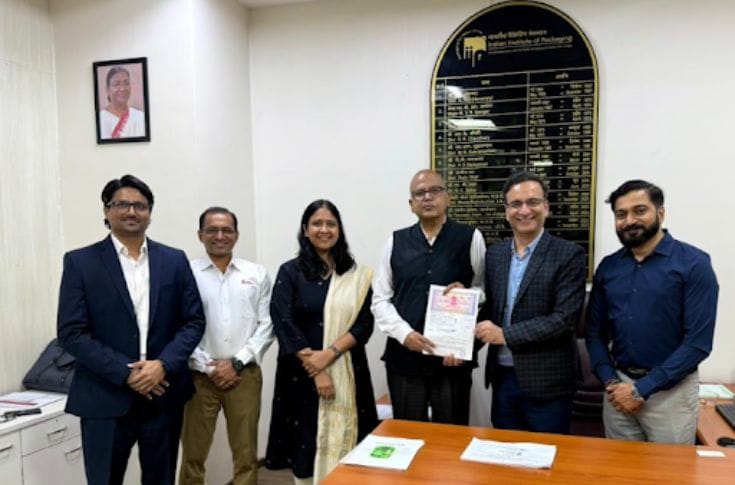
The Indian Institute of Packaging has signed a memorandum of understanding with Avery Dennison to jointly launch a management development programme aimed at mid-level packaging professionals.
The MoU was signed at IIP’s Mumbai campus by RK Mishra, director, IIP and additional DGFT Mumbai, and Saurabh Agrawal, vice-president and general manager for South Asia at Avery Dennison.
The three-day programme will be conducted across IIP Mumbai and Avery Dennison’s Pune facility, combining academic inputs with practical, industry-led exposure. It is targeted at packaging professionals working across sectors such as food and beverages, home and personal care, wine and spirits, pharmaceuticals, lubricants, agrochemicals, solar, batteries, automobiles and appliances.
The programme is designed to address emerging priorities including sustainability, compliance, artificial intelligence and changing consumer behaviour. Mishra said, “The MoU is aimed at bringing capacity building to a new level for the packaging industry leadership, with a focus on leveraging emerging opportunities while fulfilling the societal obligations of sustainable development,” .
From an industry perspective, the collaboration is positioned as a step towards structured talent development. “This MoU marks a significant milestone for the packaging industry in India, as it brings together an industry partner and an academic institution to strengthen packaging talent in a meaningful way,” Agrawal informed.
The first cohort, scheduled to begin in March 2026, will comprise 20 participants. The initiative is intended to strengthen industry-academia collaboration and support leadership capability-building within India’s packaging ecosystem.